Tuesday, December 04, 2007

Meet Fau.


Now, meet Deriki.


Together, they make up the Fau & Deriki Show...


... playing every day at an African village near me.

---------------------------------------------------------------------------------

For any other child in Patandi, I wouldn't be able to say. But when it's either Fau or Deriki crying in the distance, I can tell you without hesitation, no matter how faint the noise. It's a constant background hum that I've gotten as used to as I have the early morning roosters next door. These kids have practically become my own.

"The Fau and Deriki Show" is how I've labeled the separate folder in My Pictures set aside just for all the "awww, cuuuuute!" shots I've gotten of these two neighbors.

Fau, short for Fauzia, is Baba Juma's granddaughter. He spoils her rotten. Whether it's giving her hamsini (50 shillings) to go buy a piece of candy from the dukani down the path, or showering her with a level of affection that I've never seen him give to any of his own children, or spending time with her in the classroom of the daycare center run on his property, teaching her how to count to ten in English, Baba Juma lets Fau know that she is No. 1 in his heart.


(Except for when he tries to force her to hold onto a dead rat he found laying in their yard).

Deriki, on the other hand, is just a neighbor of Baba Juma's. But he is No. 1 on Fau's list of people she bitches around. Remember how I mentioned that I've come to know them so well that I know their cries from a mile away? Most of the time I hear Deriki crying, I can tell you who pushed him to that point: Fau.

Like the time Fau was messing with poor Deriki at our house when they came over to make tie dye shirts.


Deriki pointing fingers; Fau looking like "Who, me?"


But no matter how much Fau screws with her boy toy Deriki, they always kiss and make up.


"Fau! Mbusu Deriki!"


Usually because we force them to.


"Deriki! Mbusu Fau!"


And thus, I learned the command form of the word "to kiss," all because I love to screw with these two future lovebirds so much.

Maybe it's just because she's a few months older than Deriki. Or, maybe it's like Baba Juma says: "Girls mature faster than boys." I don't know how the precedent was initially set. What I do know is that Fau runs shit in this relationship.

She is constantly telling Deriki what to do, and he is constantly obeying. Normally, I say no chick is worth being humiliated for, but maybe Deriki thinks otherwise. Maybe Fau is just that fine on the two to three-year-old circuit in Patandi, and Deriki doesn't want to lose hold of his tenuous grip on her. She does have earrings already, after all -- and you should see that girl move on the dance floor.


And if that's the case, then Deriki is like me; he understands the importance of laying the foundation of your game early on. I tried that with Heather Siegfried back when we were eating mud together on Bluebonnet, and it didn't work. By the time I was five, she'd moved on to J.P. But that doesn't mean Deriki's plan will fail.

But he better realize soon that if he keeps calling Hunter by my name, Hatari, he may not live long enough to taste the fruit of the seedling he has planted in Fau's heart.

"I think he's just f****** with me,"
Hunter says every time he hears Deriki yell my name at him. "Every time I tell him, 'Sema Mwindaji,' he says, 'Hatari!' and laughs. The other day I swear he said 'Mwindaji,' but then he just went right back to 'Hatari.'"

"You think he's that sophisticated to be able to pull off the kind of humor?"

"I think Deriki may be smarter than we give him credit for."


Can't be that smart. As you can see, Deriki thinks he can hide from the wrath of Hunter M. Flint. Well, he's got another thing coming if that's the case. Not even his girl can save him from Mwindaji.


See?

Monday, December 03, 2007

Quick note: My hair has finally reached ponytail status, tenuously, which means I'm finally able to get this dead animal carcas out of my face. The sensation of the wind against the back of my neck is a feeling I had long forgotten. The reason I even bring this up is to show you two quotes from opposing camps, an unofficial straw poll review of how my Tanzanian acquaintances view the New Hatari.

From my student in Standard 6 English, 12-year-old Frank, who raised his hand in the middle of class and asked me to come over to his desk, as if he was confused over the formation of the present perfect tense: "Ticha BP, you look like a girl. You must cut your hair. And why do you not shave your beard? Oh, it looks very bad, Ticha. Very bad." (I had a Richard Reid beard at the time)

And from Ras Munir, our neighbor who has a tattoo of a weed leaf on his right bicep: "When I saw that you had," -- he searched for how to say "put your hair in a ponytail" in English, before going with Swahili and hand motions -- "umefunga, I thought that you looked like the man from 'Desperado.'"

Ya know, I always thought I looked like Antonio Banderas too. Whatever, Frank.

------------------------------------------------------------------------

So I wrote a few months ago about all the names I've got in Tanzania:
  • at school: Ticha BP
  • in Patandi: Hatari, Billy, Bayless (*that's once a month, maybe)
  • at the Nkoaranga Orphanage, where I went a lot in the early goings, back when I thought I had found the correct translation to "Bayless" in Swahili: Hakuna Pwani
  • at basketball, originally: Beel

Well, now I've got another. The dudes at Soweto no longer call me "Beel." They call me "B Show."

"B Show" remains an enigma to me. Every time I feel like I've got down its true meaning, I hear someone use it about another person in another context that sure doesn't apply to me.

The answers I've gotten from people have ranged from a gangsta, to a guido, to a looker. I'd prefer the last one, would take the first, and have nothing but beef with anyone who dares think of me as the middle.

"Kwa nini mnanita 'B Show' sasa?" I asked Bariki Mkubwa after about two weeks of being called this when he picks teams.

"Kwa sababu we ndo 'B Show,'" he answered without answering. "Because you are B Show."

Maybe he's just jealous of the Yao Ming Shanghai Sharks jersey and shorts that I brought back with me from Shanghai last year -- my threads bomb on his Magic jersey. But what I've heard from other players is that I am 'B Show' because of how fancy I look with all my headbands and bandanas. That eliminates "looker" from a reason for the new name. So am I gangsta, or am I a guido?

Sadly, it might be a little bit of both. I mean, have you seen "Desperado?"

Thursday, November 29, 2007

Around this time last year, I was in Istanbul. I’d just left the Balkans, for good, or so I thought at the time. A few weeks in Croatia, a dash into newly independent Montenegro, a month in Bosnia, one week in Ljubljana and then a couple of weeks in Belgrade was all I’d seen of the former Yugoslavia at that point. I missed it greatly.

That was when I read an article by my former employer called “Kosovo: The Next Yugoslav War.” Protests were mounting in the ethnic Albanian enclave that technically remains to this day a part of Serbia. Upcoming elections in Belgrade looked as if they might go the way of the Radical Party, which had nothing but hostile things to say about the future of the region. Ethnic Serbs in the Republika Srpska (RS) region of the nation technically known as Bosnia-Hercegovina were threatening to secede from BiH in the event of Kosovar Independence. War clouds were gathering on the horizon of the Balkan Peninsula once again, and there didn’t appear to be that much time left.

So I left Turkey, and thought I didn’t know it until months later, abandoned a plan I’d harbored for years, which was to travel through the Middle East at the end of college. I had to get one last taste of life in the Balkans, the Land of Honey and Blood, before it blew itself to hell once again.

Well, it never happened. The elections in Serbia, though not turning out the way it would have in a non-parliamentary system, at least failed to put the Radicals in power. Republika Srpska never had to act on any secession plans, because the UN continued to avoid making definitive statement vis a vis Kosovo’s Independence. Russia has continuously made known its opposition to a non-Serbian Kosovo: the “bad guys” in our prism are seen as fellow Slavs in Moscow, and it would also set a terrible precedent for Chechen affairs. Not to mention Spanish fears of legitimizing a Basque separatist movement, with Romanian and Slovakian paranoia over ethnic Hungarian unrest within their borders not helping the Kosovar Albanian cause much either.

War never came in the Balkans because everyone was able to delay and stall and convince themselves that everything would end up all right. Now, it seems that we’re about to be reminded of that simple truth that exists in the Land of Honey and Blood: very seldom does everything end up all right.

They held elections in Kosovo on November 18. The new prime minister has stated a December 10 date for a unilateral declaration of independence. Russia will not be able to block it. The Western response will dictate the course of events that are to transpire. I'd prepare for the worst.

Monday, November 26, 2007

Four quick photos.

1) Mohammed.


One of the veterans at Soweto, his jumpless J reminds me of a skinny, dreadless Sam Perkins. His day job, though, is mandazi chef on the streets of Arusha.

Mohammed is the man.

-----------------------------------------------------------------------------------

2) One of our several house mates.


We pretty much coexist.

------------------------------------------------------------------------------------

3) Tanzanian Driving School.


It's an oxymoron: "Tanzanian" and "Driving School" together. People here drive like it's Independence Day; pre-Jeff Goldblum solution to save the world.

I always try to get lifts from these cars. They never pick me up, even though it's something every driver needs to learn here, just as we all learn how to go through the Drive Thru in the States.

Karma took care of them on this day.

-----------------------------------------------------------------------------------

4) An African Teacher, indeed.


Of course, Burning Spear is actually Jamaican, not African. But his message is for the Diaspora, and I'm glad to see some Tanzanians taking note of his lessons.

I love Burning Spear. His show my last semester at UVa was one of the best concerts I saw in college. When I pulled out my camera to snap this shot -- I just had to do it -- they started yelling at me from across the street: "Mzunguuuuu!"

How else could I respond but with the bass line to "Old Marcus Garvey."

"BUM BUM, BUM, BUM-BUM, BUM-BUM, BUM, BUM-BUM, BUM-BUM, BUH DUH-DUH, DUH, DUH-DUH!"

"YEEAHHHHH!!" the African Pupils all screamed. A Mzungu knows Burning Spear!

Seen.
Full mzukah!
cuz I'm a Nako 2 Nako soldier...

A-Town. (*gang symbol copyrighted by Bariki Mdogo, 2007)


“I think it’s so funny how at the beginning, we woulda been like, ‘Yeah! We’re gonna go to this STUDIO, we’re gonna chill with these dudes OUR AGE – maybe we can like, invite them back to our place, and we’ll like, chill with them. Yeah!’” Hunter screamed. Cars whizzed by us on the Nairobi-Moshi Rd., laying on their horns almost as thick as he laid on the sarcasm. He switched back into his normal voice: “Now, I’m totally just looking out for what these guys might try and pull.”

Pulling us out of bed before noon on a Saturday morning was the first thing. One of our boys from our five-on-five pickup games at Soweto had basically tricked us the previous afternoon into coming.

“Beel,” he had said, pulling me aside after the last game (a lot of Tanzanians not only have trouble saying my name, “Bayless,” but also my name-for-people-who-have-trouble-saying-my-name, “Billy”). “You will come to the studio tomorrow?”

Studio? He popped the question like he was just confirming some earlier pledge I'd made.

“Uhh…” It wasn’t that I saw a problem in it, just that I was a little confused.

“Hunta said he will come,” he lied.

“Oh,” well if Hunter said it was cool, “then yeah, what time?”

“Saa tano,” he said, “five o’clock” meaning 11 a.m. in Wazungu time. Our day starts in the middle of the night; East Africans use a more logical method, zero hour coming with the rising of the sun, six hours after what we refer to as midnight.

Safi,” I said, giving him the Tanzanian slap-shake/thumb-snap that bombs on our boring Anglo-Saxon handshake. “Tutaonana kesho.”

---------------------------------------------------------------------------------

The only name we’ve ever heard anyone call him is Ice Pee. That includes his brother who also plays at Soweto, Bariki Mkubwa (Swahili for “Big Bariki,” not to be confused with a smaller, flashier guard who also plays at Soweto, Bariki Mdogo). "Ice Pee" is a valiant attempt at a badass rap name that falls tragically short -- it makes you giggle too easily. Until I saw it Sharpied onto the back of his blue Kili Basketball jersey early on in our time at the court, right above the also Sharpied on numbers, printed in big, bold, all-capped letters for all of Soweto to see, I never knew that ice could flow not only through a person's veins, but also through his mushroom tip.


"Do Tanzanian women know about shrinkage??"


Ice Pee.

Hearing it uttered is almost as unintentionally funny as when someone points at a rooster and excitedly exclaims, "Cock!" to impress you with their English. Since I don't know the word for urine in this language just yet, the best I could do for him was to translate "Ice Pee" into the verb form, literally "to urinate ice."

Ladies and gentleman! Putchyo hands togetha for the one and only ... Kukojoa Barafu.

Not quite the same ring to it, huh?

Ice Pee, like my boy from UVa, Big O, has a dream of hitting the big time in the rap game. Though I suspect he’s actually just a 25-year-old virgin, or just really, really scared of getting AIDS, he once told us that he hasn’t had sex in three years, “because of da hip hop, man,” as if being so focused on rapping prevents him from even contemplating making moves upon moves on femininas. In other words, hip hop is Ice Pee’s life; the rest is just details (No. 1a being hoops).

It makes sense that the name of his upcoming album, which he is recording one TSh 50,000 (~$45) track at a time, is “Mpira wa Kikapu,” Kiswahili for basketball. I’ve got two of his songs on my iTunes, and even though I understand very little of the rhymes without Biti’s help in translating, they’re not bad.

Last Saturday, he invited me and Mwindaji to come to the Noizmekah Studio to see where the magic happens.

“Tutaonana pale juu Treepull A,” Ice Pee had said when we were arranging a meeting place. “Treepull A” is a ghetto fabulous Arusha night club that doubles as a hip hop radio station during the day. Hunter and I hear nothing but warnings about it from every Mzungu that’s been – “There’s always at least one fight when you go to Triple A" – but since we have no car, and no desire to pay the TSh 12,000 cab fare each way to see for ourselves, we can neither confirm nor deny. But as we strolled through the AAA gates for the first time that morning, about 15 minutes late because of the unexpected early drop off by the Wazungu aid worker couple that had picked us up on the side of the road, I could see why AAA’s reputation was so notorious.

We were fish out of water, even in the middle of the day, when no one but the early shift was around, save for a few loiterers sprawled across the grass out front. About ten sets of jaundiced African eyeballs scoped us up and down as we made our way through the parking lot, Ice Pee’s not among them. We were the only white boys there, something unremarkable for me and Mwindaji, seeing as we have almost no Mzungu friends at all. For whatever reason, nothing quantifiable, AAA just felt dangerous. I thought this to myself; Hunter later vocalized it.

Thirst had been the only thing on my mind from the time we had hit Mianzini, about a ten minute hike from where the Church’s had dropped us at Sanawari, site of Arusha’s brand new (and only) traffic light, which is about a month old.


On "The Road of East Africa," as a wise man once said, things are getting better and better and worse and worse, faster and faster


We’d walked about 25 minutes in all from the point where we watched our ride turn left into town. It was hot outside. Africa hot. As you could imagine, I wasn’t lacking in the back sweat department. Now, though, finally safe under the shade, my eyes locked onto the centerpiece of the semi-circle shaped bar in the corner of the canteen. It was a fridge, gleaming with fluorescent light and stocked with a whole truckload of the Real Thing, and it sucked me in like a tractor beam.

“Coca Cola mbili,” I said to the woman standing behind the counter, theoretically at work, though doing very little.

“Baridi?”

“Ndiyo.” Tanzania is the first place I’ve ever been where a server will ask you if you want your Coke to be cold. Not “Ice or no ice?”, but simply “Hot or cold?” A chronic lack of refrigerators and regular power outages has produced a populace that often prefers warm beer or soda.

Mwindaji and I each take down an average of three Cokes per day. Sometimes we drink more, sometimes we drink less, but we never do we drink none.


Without a trash disposal service in our village, we've stockpiled enough of these babies to melt down a month's worth of bullets for our boys in Anbar Province


It’s a guilty pleasure that I don’t feel guilty about. I feel like I owe it to myself to drink as many Cokes as I can when in the land of the omnipresent glass Coke bottle. Plus, for whatever reason, my usual favorite Pepsi sucks here. And with nothing to do after work except play basketball and watch the Africandle pick up wax ...


The Africandle on Halloween. Lookin' good...


... I look forward to the Cokes. Our nightly routine, usually when we get home from playing, is one person cooks, while the other goes to the duka up the dark path from our house and gets four bottles – one each with dinner, one each for chilling afterwards. At 300 shillings a pop (no pun intended, bahahaha), or about 25 cents each, I’m pretty sure Hunter and I are going to put the grandchildren of our local duka’s owner through college with our constant business. That, and I am probably going to personally pay off Dr. Nick Pigneri’s mortgage with the amount of dental work I’m going to need to repair all the damage being wrought to my teeth -- they use pure sugar cane in the syrup around these parts, not high fructose corn syrup like we’re fed in the States.

Ordering a Coca Cola baridi to combat the East African heat is not a good idea, especially in November -- summertime in the southern hemisphere, remember? Six sips – or three mega gulps, if you go by The Bob’s definition of the word “sip” – and it's kicked. And you're still really thirsty afterwards. I knew all of this when I walked up to the bar at that AAA canteen, and I didn't care. We killed those Cokes.

Twenty-five minutes after that, we were still waiting. Big surprise. It's for inevitable delays such as those that I always try to go around town with a book in my backpack. Three weeks ago, I was in the middle of a 59-year-old man’s story of his solo journey from Cairo to Cape Town, Dark Star Safari, by Paul Theroux. I was chillin'. Hunter, on the other hand, had nada. He was restless.

“Dude,” I heard an impatient voice say from across the plastic table after a good half hour of waiting, “you ready to roll?”

Really restless.

"Africa Time" is the name Wazungu use in these parts describe the chronic lateness of Africans. A rule of thumb for newcomers: when someone says “five minutes,” they really mean, “at some point in the next ten hours.” That, or simply, “when I feel like it.”


Hard at work


“Just give me five more minutes,” I said, hardly bothering to lift my eyes from the book, engrossed as I was in the chapter on Zimbabwe. Africa Time is beginning to infect me, too.

(*Note the striking similarity between what my Uncle Tom McNearney refers to as “The Parsley Shuffle” and Africa Time.)

Like I said, I didn’t even lift my eyes from my book, but I’m almost positive he rolled his. When Mwindaji gets homesick, he can usually count on the regular phone calls Mr. and Mrs. Flint make to his TZ cell phone. When I get homesick, all I have to do is remind myself that I’m basically living in an entire nation of black Parsley’s, where everyone is late, all the time.

Dark Star Safari just happens to explain the historical origins of Africa Time, a.k.a. “The Black Parsley Shuffle,” in its chapters on Tanzania:


I sat on the platform among the delayed passengers. No one really minded the delay. If there was anything to learn on a trip such as this it was that in East Africa urgency was a foreign concept. Though there were a number of words for urgency in Swahili, lazima and juhudi and shidda [sic] and haraka, none had Bantu roots; all were based on loan words from Arabic. In East African culture, hurrying had a negative connotation, illustrated in the rhyming maxim, Haraka, haraka, haina Baraka – Hurry, hurry makes bad luck [that’s not actually what it means; “quickly, quickly, without a blessing” is more on point]. Of course, some Africans were driven mad by such lack of urgency and tried to emigrate. But in general such complacency made people patient, as well as accounting for the utter indifference to things going wrong. In a place where time seemed to matter so little, there existed a sort of nihilism which was also a form of serenity and a survival skill.


Right, on, the head. A ten.

Two minutes into my “five more minutes,” Mwindaji’s phone rang.

“Ice Pee,” he said once he hung up, after spitting a few Swahili sentences into the receiver. “He’s here.”

-----------------------------------------------------------------------------

Ice Pee is always good for a smile. I love Ice Pee. I don’t see him nearly enough. Every time he rolls up to the court -- usually once we’ve already started warming up with two teams taking shots from the elbow to 20, or the old fashioned left handed lay up drill -- I can count on a big grin and some sort of slang Swahili salutation: “Niaje msela!” (What up dude!), “Inakuaje mchizi?” (How’s it goin’ homey?), “Mzukah, mzukah! FULL mzukah!” The last in that series isn’t exactly a greeting so much as the current darling of the meaningless street Swahili lexicon – if you speak Kiswahili cha mtaa, you’re using “full mzukah” for everything these days. “Mzukah, FULL!” this, “FULL mzukah!” that. Full means exactly what you would think. Mzukah is the word for some sort of ghost. Think of the equivalent in street Kiingereza: “phat,” “badass,” “word.”

Ice Pee loves to yell “FULL mzukah!”

“Mambo jamaani?” he roared as he approached the canteen. How are things y’all?

“Umechelewa bwana,” I said, pointing to the watch that no longer covers my left wrist. “Inakuaje?”

“Mzukah, mzukah!” he yelled with a big smile, strutting that strut of an MC in training. “FULL mzukah!”

Classic.

He was wearing the red jersey this time, a big, solid No. 13 colored in carefully on the back with magic marker -- a poor man gangsta’s making do for his lack of Mitchell & Ness threads. On his head was a blue and white striped train conductor’s hat, something I’d definitely rock myself if I ever found one that fit my Kevin Mench sized skull.


"It's YUGE!"


People here shop for used clothes at the outdoor sokoni with the intention of finding something they think looks brand new and hip. I shop for the same used clothes at the outdoor sokoni with the intention of finding something that looks old and alluringly ugly. Poor black Africans, rich white Americans – we’re all trying to be something we’re not.

The ridiculousness of my attempt to "relate" to people mired waist deep in Third World poverty is made especially clear when I'm walking around poor neighborhoods in Arusha. Who the hell do I think I am to try and "study" these people? So I'll stop and eat with the commoners at a dive rice-and-chicken bar; it doesn't change the fact that all I really am is just another slum tourist.

When I really check my motives, that's what I am: a slum tourist. Lots of guilt and embarrassment are involved – guilt that I could have ever felt deprived because my parents wouldn’t buy me a Nintendo; embarrassment that my yearning to “understand” what life is like for those Bob Nesta calls the sufferahs has taken me halfway across the globe to gawk. I feel so superior to all the "rich Mzungu tourists," and yet I know deep down that I'm no different in the end.

The fascination I have with the former Yugoslavia has been called “war porn” by several of the journalists who wrote books about their time on the front line in the 1990’s. Images of a big, happy family tearing itself apart at the seams seems to make those of us from boring old Western countries feel more alive. Since Independence in 1961, Tanzania has been unable to provide headlines as juicy as those describing the disintegration of Yugoslavia, but it can still offer a traveler from a boring old Western country the opportunity to feel more alive.

I’ve already called it slum tourism; maybe “poverty porn” fits as well.

I’m no rookie to poverty porn: in Trenchtown, Jamaica, in the Balkans, even in Houston’s own Third Ward (or should I say “Developing Ward?”), I experienced the sensation: I am one of the lucky ones. The rat race in Tanzania outdoes them all.

---------------------------------------------------------------------------

its big fun to be rich


I saw this graffitied on the wall and wished I could turn myself invisible for a few seconds -- the wide-eyed stares I get when I pull out my camera here only reinforces my slum tourist insecurities. A shame, too. That tag captured the mood of Arusha's streets perfectly. The love of money is greater here than anywhere else I've ever lived -- including Geneva.

“Tumeshafika,” Ice Pee said, letting us know that the approaching gray metal gate in the middle of Sanawari was the place. Hand painted on the left side of the gate was the name of the studio: NOIZMEKAH.


------------------------------------------------------------------------------

It was crazy how quickly it happened, and how easy it was. DX, the producer/owner/100 percent of the one-man operation that runs Noizmekah, which is simply a house with a built-in studio, heard from Ice Pee that Mwindaji could beat box, and after exchanging the standard pleasantries in Swahili, came out with it.

“You wanna lay down a track?”

(insert sound of tires screeching here)

Confusedly looking to both sides, Hunter hesitated. “Yeah,” he finally said, still not totally sure whether the offer was genuine or not.


Years of practice have led to this moment

As you can see, it was.

Before he knew what had hit him, Mwindaji found himself inside a small, rectangular room, surrounded by walls lined with egg crates, staring at the rest of us through a plate glass window with his back to the large square mirror hanging on the opposite wall.

“Tayari?” DX asked from his seat at the computer.

Headphones on, Hunter was ready to go. He nodded. Tayari.

What followed was something I’ve heard countless times in the five-plus years we’ve been best friends, but which was new to the rest of the five people in the room. If you haven’t had the pleasure of hearing Hunter beat box, I assure you, he is good. So good that when I found out the car he drove our last year of college didn’t have a radio, I didn’t even care.

Without almost any warm up at all, MC Mwindaji (just came up with that on my own) proceeded to lay it down.

How does one describe such a symphony of sounds? How about mzukah. That’s what a gangsta Tanzanian would probably say on the street. But since Kiingereza cha mtaa is my native tongue, I’ll go with “f***in amazing.”

His first take was just a freestyle beat box session, laying a grid for the next two takes. He added some scratches in on the second go-round, listening to his first cut on the headphones while he worked. The third and final take were just vocals, thought up on the spot to fit in between the beat he’d just created.

“Hot daaaays, cold niiiights, I’ve been playin’ baaaall, my whole liiiiife…” he sang. Ice Pee wanted a song about basketball, and that’s what he got.

“Is that freestyle?” DX asked me, as he popped a 180 on his swivel chair.

“Yeah.”

He shook his head and swiveled right back, staring at a colored screen which was charting all the peaks and valleys of Mwindaji's music. DX, who has worked with tons of Tanzania’s most popular hip hop groups, and who definitely knows what he’s doing, was clearly impressed.

“…my whole liiiiiife, my whole liiiiiife…” reverberated through the computer speakers.

The video I took of the room shows one guy who is straight jamming; huge grin on his face, bobbing his head up and down the whole time. Ice Pee looks pretty pleased that his Mzungu friend is making him look good.

It only took about ten minutes, and the track was ready. Just like that.

Ice Pee said he’s going to put it on his album, a guest interlude of sorts for MC Mwindaji (that rhymes if you pronounce it correctly: mween-die-jee). And even though I can’t beat box or sing, Ice Pee has been pushing me to record the “outro.” Not able to freestyle like Hunter, I’m still in the process of writing my Kiswahilinglish contribution. It’s far from complete, but I came up with a few rhymes that very day, sung to the beat of my favorite Swahili hip hop song, “Hawatuwezi” by Nako 2 Nako:

Wazungu wawiliiiiii
(Two white boys)

Wamekuja Tanzaniaaaa, kucheza basketiiiiii
(They’ve come to Tanzania, to play basketball)

Mwindaji na Billyyyy, also KNOWN as Hatari, au Ticha BPeeee
(Hunter and Billy, also known as Danger, or Teacher BP)

Wazungu wawiliiiii, msiwapimeeee, mkitaka kuishiiiiiii
(Two white boys, don’t try them, if y’all wanna live)

duh duh duh duh duhhh, awwwww ooooo ahhhh
(You’d have to have heard “Hawatuwezi” to really get that)

"Hawatuwezi" and Nako 2 Nako have been as integral to my time in Tanzania as Beogradski Sindikat and "Alal Vera" were to my time in Serbia. If you listen to hip hop in Arusha, you are a "Nako 2 Nako soldier." I will write a lot more on this topic later, I promise. But it's good to know that Ice Pee and Bariki Mkubwa are keeping it real in their alley.

Two Nako 2 Nako soldiers live this way...

-------------------------------------------------------------------------------

Anyone who ever goes on safari in East Africa comes home remembering three things in Swahili: jambo, hakuna matata and karibu.

The first two are tourist trap alert words – if you hear them, run. Ninety-eight percent of non-hustling Tanzanians use mambo (the plural form of jambo) for a standard greeting, and NOBODY says hakuna matata, ever, unless they’re singing a children’s song.

Real people say hamna shida; guys who say mzukah say hamna noma.

Karibu is different. It’s not a tourist trap alert word; actually, I’d say it’s one of the most used words in the whole language. It means “welcome.” When you say thank you: karibu sana; when you enter someone’s home: karibu ndani; when you pass a friend on the road: karibu kwetu; when you’re in an awkward conversation with a Tanzanian who doesn’t know what else to say besides more of the same: karibu, karibu sana; when you leave a store after you’ve just bought something: karibu tena; when you’re being harassed by a random drunk at a local bar: karibu Tanzania!

Nobody ever says it just once. They say it over, and over, and over again to the point where I’m not even sure I truly understand the meaning of the word.

-------------------------------------------------------------------------------

Ice Pee’s dad, dressed to the nine’s for a wedding he was about to leave for is one of those guys who spits out karibu’s at a semi-automatic clip.

“Karibuni, karibuni sana,” he said as soon as Mwindaji and I walked in behind his son. (You add an –ni to the end if you’re saying it to more than one person.)

“Asante sana,” “Asante,” we answered simultaneously.

The man’s football brown suit and crisp white collar gave off the vibe of an evangelical Mississippi preacher. I wondered if the fact that the son he named Pendoheri was now going as “Ice Pee” made him shake his head in the same way a black southern reverend would bristle at his own kid listening to 2Pac. When we shook hands, though, he didn’t seem too worried about it. Baba Ice Pee (a man’s name becomes “Baba [insert name of oldest child here]” when he has a kid) had a big smile on his face. He really seemed honored to have these two random Wazungu as guests in his home; I’m guessing it was a first for him.

“Karibuni, karibuni,” he reiterated.

“Asante sana.”

“Karibuni Tanzania.”

Asante.”

“Ahhhh,” – (smiling and shaking his head) – “karibuni sana.”

“Asante sana, bwana.”

He paused – but just for a moment.

“Karibuni.”

It would have gone on like this for at least an hour had he not thought to ask what we might want to drink.

After it became clear Hunter wasn’t going to ask, I stepped up to the plate and said it: “Coca Cola zipo?”


Really making a difference with Ice Pee


Trying to translate American rap songs into Swahili would be hard even for a native speaker – there just aren’t enough words in their language to handle that kind of verbal diversification from another. For me, someone who heard his first Swahili just under five months ago, it’s even harder. Is it fun to try? Yes. Does it butcher any semblance of art that could be absorbed from the music? Yes again. Really tough lines that might originally come outta Compton as “whatchyou wearin’ be poppin’ da spot” can only be translated into something like “ulichokivaa kimefurahisha” with four and a half months Kiswahili experience. Literal meaning: “What you’ve worn has made me happy.”

The truth of the matter is that some words don’t have equivalents at all. For example – and this may be hard to comprehend for a lot of other rich white kids out there – there is no concept of “sticky icky icky” in Tanzania. This is the Republic of Shwag we’re living in. They have no knowledge of The Chronic.

If they did, though, it would help to explain the striking similarity between the words kusinzia (“to fall asleep”) and kusizi (“to be stoned”).

“Still … represntin’ fo all tha gangsta’s all across da world …”

Bado … nawawakilisha masela dunia nzima …

Basketball lingo is much easier to deal with than Ebonics.

Ice Pee came back into the room and plopped back down onto the couch beside Mwindaji. He had just gone to his room to grab a thick white binder, like the ones you get for your ninth grade English class. the mannice p” was written in marker at the top, with newspaper clippings of random NBA players (DeShawn Stevenson? Really?) and big-breasted models plastered all over the front and back covers. The binder was full to the brim with frayed white pages.

“Are those all rap lyrics?”

Nearly a decade after “Chronic 2001,” American rappers really are still representin’ fo all tha gangsta’s all across da world. And the streets are still returning D.R.E.’s love on a global scale. Ice Pee’s binder was an organic reflection of that uniquely American form of imperialism, which transplants its values not by force, but by its pop culture’s sex appeal (*Islamic nations not included). In case of a fire, there is no doubt in my mind as to what Ice Pee is going for before all other considerations. It was a Who’s Who List of New World Order Hip Hop in that thing: Biggie, Pac, Wu Tang, Dre, Snoop, a ton of Lost Boyz, Nas, R. Kelly and even Nelly, not to mention dozens of others.

So there we were, Hunter and I, now chilling not just with Ice Pee but also with Bariki Mkubwa, who dominates his big brother on the court, but not in the rap game. Ice Pee had our undivided attention. Two Wazungu with a knowledge of English hip hop slang, in his living room, ready to put the pieces together on any one of those songs that he knew by heart, but without any understanding of its meaning.

He could have chosen any artist.

He chose Lil’ Bow Wow.


“We playin’ BA-SKET-BAAAALLLLL! (Something something) BA-SKET-BAAAALLLLL!”


Don’t even pretend like you don’t know which song I’m talking about.

As hard as it was to believe at first that a person above the age of 10 could still like Lil’ Bow Wow in the year 2007, it wasn’t too hard to put myself in Ice Pee’s shoes once I thought about it for a second. The two burning passions in Ice Pee’s life, American exported hip hop and American exported basketball, coming together, as one, and creating the fullest of mzukah tracks in the binder in the process.

Remember that the name of Ice Pee’s debut album currently in the works is Mpira wa Kikapu, Swahili for “basketball.”

It worked out perfectly, actually. Everybody won. Ice Pee and Bariki Mkubwa finally learned about what an “alley oop” is (no one at Soweto can throw it down, so they have no use for the term), as well as the key to an especially cheesy pun of Lil’ Bow Wow’s about “Darius throwing it down from Miles away” or something.


Mwindaji and I learned how to say “Don’t try me” in Swahili (Usinipime), for use some day when I’ve got the ball at Soweto, and I also jotted down a ton of other terms to use at the court, some taken from the song, others I asked about while we were on the topic:

to block – kuzuia
to stuff a shot – kupiga tawi
to cross over – kupiga chenga
to dribble – kudunda
blind person – kipofo
“He has a big head” (literally just boring old “He is proud of himself”) – Anajisifu
perfect – timilifu
“I am the Truth” – Mindo Mkweli
“I’m in shape” – Niko fiti
“I own you” – Nakumiliki


It was truly one of my best days here. Trust is such a constant issue with us, as two Wazungu in a sea of people accustomed to getting handouts from anyone with white skin. We get cheated, lied to, and stolen from all the time. There are only two or three Africans I will let into our house, for fear of wide eyes translating into big stories about abundant wealth. The only security guard we've got is a machete; I really don't want to have to use that thing.

When we were walking to the studio that morning -- before any notion of Hunter recording a song entered our heads, before we spent more than an hour just chilling, translating hip hop songs into Swahili, before we went to a ghettofied Tanzanian coffee shop nearby Ice Pee's house, and before they went to pay for dinner at one of those dive chicken-and-rice bars I mentioned earlier -- Hunter made a comment about "looking out for what these guys might try and pull.” We were braced for a blow that never materialized, and it made me smile as a result.

The simple fact that neither Ice Pee nor Bariki Mkubwa never pulled a thing meant more to me than anything else they could have done for me. It may sound amazing that the act of not getting played would make me so happy, but that's just life for a Mzungu in an African's world. Besides, even if they tried, hawaniwezi, cuz I'm a Nako 2 Nako soldier.

Thursday, November 01, 2007

We went with our three wageni -- Emily, Emily's dad Tom, and her friend Erin -- up to Nkoaranga Orphanage a few days ago, and this is the compassion Mwindaji showed for darling little Wema when she expressed her disappointment with not being allowed into the classroom that we painted earlier this year when the Belk's were in town.


Wema's name means "good" in Swahili.


And then there is Erin, who ironically looks very Anglo-Saxon, while everyone assumes I'm Jewish around town (my question is, how do Tanzanians know what Jews look like?). It's ironic because she actually is a Heeb, and I only feign as one.

That point is not relevant to anything, really. But on a related note, that being Erin Fleischer, what is she looking at??

Monday, October 29, 2007

A diehard Boston sports fan. Married to a cool ass chick. Livin' the life in CA, writing for ESPN.com, making money talking about sports, "Lost" and your relationship with your father. Proud father of one little girl, with another bun in the oven, and due to come out anytime now. KG about the make his Celtics debut, the Pats rolling over yet another opponent, and then, his beloved Red Sox win their eighth straight Series game in the past four years for their second sweep in as many chances.

This excerpt from Bill Simmons' new article on ESPN.com captures a moment that leaves me dreaming of mine to come.


For instance, before 2004, I never would have called my father for a "Who's winning the MVP?" conversation before the final out. I never would have started recording the ninth inning on our bedroom TiVo just to give the World Series celebration "SAVE UNTIL I DELETE" status. I never would have pulled my daughter out of bed after the seventh so she could watch them win, even though she yelled, "No, I don't like baseball!" every time we turned on a playoff game this month. Things are just different now. The 2007 Red Sox were really good, they will continue to be good, and that's just the way it is. They weren't going to blow Game 4.

I promised my daughter there would be a payoff at the end -- that somebody on Colorado would make an out, that the Red Sox players would jump on each other and celebrate, that there would be dancing and hugging and everyone would be really happy. She understands absolutes (words like "happy" and "dancing" and "hugging") and understood something special was about to happen, but she had never heard the word "celebrate" before." She liked the way it sounded, so she kept saying it. Celebrate. Every time something happened in the last two innings -- a strikeout, a groundball, whatever -- she'd ask me why they didn't celebrate and I had to keep telling her, "No, you'll know when they're celebrating, I'll tell you when."

Eventually, she started watching me to play off my reactions. When Jamey Carroll cranked that one-out, 0-2 fastball in the ninth, for a split-second, like every other Sox fan who had abandoned their anti-jinxing rituals, I thought I had screwed everything up and screamed, "Noooooooo!" before Ellsbury hauled in the catch and she asked me what happened.

"That guy almost screwed it up," I told her

"Oh." She thought about it for a second. "They're not going to celebrate?"

"No, no, they're about to celebrate," I told her.

We moved to the edge of the bed. I was sitting down; she was standing between my knees and leaning against me. Paps uncorked a 2-2 fastball for the clinching strike ("Yesssssssssssss!!!!!!!!!"), whipped his glove in the air and flipped out like he always does. If there's an enduring image of this 2007 Red Sox team, it's the sight of a wild-eyed Papelbon waving Varitek towards him for a postgame embrace -- he always looks like some drunken Boston kid who just sucker-punched somebody in a bar and wants the fallen guy's buddies to run over for a full-scale brawl. COME ON!!! LET'S DO THIS!!! Once Varitek jumped into his arms, the entire Boston team mobbed them within seconds, and everyone eventually settled on jumping up and down in a delirious circle. A few seconds passed before my daughter finally turned to me with a big smile on her face.

"They're celebrating," she told me happily.

I don't know how I got here.


Some day, I can only hope to be sitting with my own kid, whom I am supporting through money earned from writing, watching the Astros win their second championship in four years, as the Texans continue to dominate the AFC, and the Rockets look set for a revival.

Oh yeah, and it'd be great to see UVa make the Final Four, too.

Saturday, October 27, 2007

The World Series from a world away.

LUGO! JULIO FREAKING LUGO!

How is Julio Lugo playing in the World Series? How is he making key plays in a game that will basically put the whole thing out of reach? Didn't he single-handedly tank the Astros' 2001 Division Series with Atlanta when he Buckner'd that easy grounder in Game 3? Why couldn't the ball have rolled through his legs in this series, like it did back when it was hurting Houstonians, not Denver...ites?

---------------------------------------------------------------------

That's right, I'm watching Game 3 live from East Africa. And it's only because of a (very) timely visit from Tom, father of one of our co-workers, Emily, who also just happens to be in the neighborhood for a three week visit at just the right moment. Tom, Emily and her friend Erin (Sox fan) are staying at a badass resort in Usa River, just up the road from our village in Tengeru, and we're stretched out on cushions and pillows atop the floor in the Ngurdoto Mountain Lodge Internet room.

It is great to be part of Generation Anything is Possible with Ethernet.

---------------------------------------------------------------------

The last game I watched was, I don't know actually. It was before Craig Biggio's 3,000th hit, I can tell you that much. Even though I left for Africa a solid two days after that night, I didn't even get to see it -- a spur of the moment offer from Mr. Weinreb, one of The Bob's friends in Dallas, to come fly up for dinner then head home (not even joking), led me to hedge on Biggio not getting the three hits he needed to reach the mark we'd all been waiting for.

And I was right, he didn't get three hits. He got five.

---------------------------------------------------------------------

So I'm back with the MLB, and it's just in time to see the fourth crap World Series in four years. It's almost 6:15 in the morning here in Usa River, and the sixth inning isn't yet over. I love this game.

---------------------------------------------------------------------

A few thoughts.

The steroids ad sponsored by the Partnership For a Drug Free America (which organizations are actually included in this partnership, by the way?) is awesome. The basketball deflating, the announcer cryptically alluding to the fact that roids are going to shrink your pumbu, as they say in Swahili, and just the whole presentation is top notch.

---------------------------------------------------------------------

Joe Buck, you're funny. Tim McCarver, you're not.

Buck's joke (upon seeing a heavily bundled Kevin Youkilis, sitting on the bench in the cold Colorado night air for the first six innings): "Kevin Youkilis, sitting on the bench, dressed like he's ready for the Iditarod."

I let out a hearty laugh when I heard that one. And I especially loved the repeated shots of Youkilis in the dugout later in the game, after he'd already taken Papi's spot in the order, wearing a hoodie and some sort of industrial fireman mittens, practicing what could have either been his batting swing or a new form of mixed martial arts.

Then, the McCarver joke: "Youkilis now in the game, wearing only short sleeves. He's the only Red Sox infielder not wearing long sleeves, while earlier, he was sitting on the bench dressed like an gnome."

"A gnome," Buck corrected.

"Yes, a gnome, a gnome."

McCarver. First of all, he didn't look anything like a gnome. Second of all, shut up.

---------------------------------------------------------------------

Also, McCarver used the word "bevy" to describe the high quantity of fastballs Daisuke was throwing early in the game. You know he had that word written in Sharpie, circled twice to keep his attention, taped to the wall right above the press box window. He was waiting to say "bevy" like Manny waits to smash a hanging breaking ball out of the park in that thin Rocky Mountain air. Manny impresses me; McCarver doesn't.

---------------------------------------------------------------------

Rockies' players who don't have big biceps have no way to hide that fact.

Even though it's dipped into the upper 30's in the late innings, they're wearing the equivalent of a Sixers jersey over a "We must protect this house!" long sleeved undershirt. If you swapped Tulowitzki with Lugo, I guarantee you Rockies fans would laugh him out of the ballpark, maybe all the way to Idaho. Lugo, after all, looks like Danny Almonte ... at age 14. He is the one guy I can say with 100 percent certainty did not take steroids in the past ten years.

I would be scared to see what Barry Bonds looked like in a Rockies uniform next season.

---------------------------------------------------------------------

The little girl whose father has repeatedly made her stick her head into the middle of a homemade bullseye that reads "HIT IT HERE!" will probably have to undergo years of therapy after this series, as Tom remarked earlier.

---------------------------------------------------------------------

Rockies fans are rowdy, you have to give 'em that. They bomb on Astros fans, who leave early in the last game of the first World Series in club history ... when trailing by one run in the ninth.

---------------------------------------------------------------------

Watching games on mlb.tv kinda sucks. As the sun rises, and the new day invites more and more Internet users who are checking their email before work, there are more and more freeze delays. Usually, they happen in the middle of a really important play. For example, Matt Holiday's three-run homer in the seventh. The computer was frozen for about 45 seconds; all of the sudden, we see that classic FSN all caps indicator across the top of the screen, frozen in time just to rub it in Erin's face (she is from New England): HOME RUN ROCKIES.

Seeing as we'd been up all night, and it was past 6:30 in the morning, our celebration was muted, to say the least.

---------------------------------------------------------------------

I hate the Twix commercials they force you to endure every time you reboot the window, too. We've had to reboot about 20 times. So I've had to stare at the cover of a book called "How to Land a Mega-Hottie" about 15 times, since there is another Twix commercial that they rotate in occasionally.

"Adam? What are you reading?"

(shudder)

---------------------------------------------------------------------

It's 7:30 a.m. now. Breakfast has been served; all the old Euro tourists with man-pri's and nice Adidas shoes are out; Rockies are down 9-5, two on, two out, bottom eight, Papelbon on the hill.

---------------------------------------------------------------------

FOUR TIMES TONIGHT I thought Colorado had one going out. Every pop fly in Denver, I yell, "Get it! Get it! GET GET GET!"

The one time one actually went out, the computer was frozen.

---------------------------------------------------------------------

So that new Will Smith movie coming out called "I Am Legend" really got me when Fox started to pull a TNT and incorporate its upcoming movies into its coverage of the baseball postseason. Scrolling across the bottom of the screen in the sixth was a logo for the film, next to rolling footage of Kirk Gibson's Game 1 shot in '88.

"Legends of the World Series" was allegedly coming to theaters December 14.

"Whoa, that movie is coming out in theaters??"

"Who would go to that?" Tom asked out loud.

"Man, I'd go to that!"

"Yeah, you and eight other guys," he said.

"Y'all, that's just Fox advertising for its new movie," Hunter deadpanned from the back. His eyes were as glazed as a Shipley's donut from the lack of sleep, but he was still alert enough to realize a movie about the great World Series moments wasn't coming to theaters in December.

"Oh," I said. "Damnit."

----------------------------------------------------------------------

Thankyou, Joe Buck. You win the award for first non-local broadcaster to call Willy Taveras, Willy Taveras, not "Tavarez."

------------------------------------------------------------------------

Does Mike Lowell's skull tilt in the same direction as his scrotum? The man with only one ball, a result of testicular cancer, wears his helmet like he's hiding a stack of $20 bills on one side.

--------------------------------------------------------------------------

Matsuzaka brought honor upon his people. Okajima brought shame.

---------------------------------------------------------------------------

Final score: Sox 10, Rockies 5.

Final "should be" score: Rockies 1,000, Sox 7. (Daisuke gets 2 RBI? Lowell gets a free pass to third in the top of the ninth, then scores on a sac fly? Lugo playing balls to the wall in the field? The humidor doing a disservice to its own team? Rockies should have taken it all the way home tonight).

Err... I mean this morning. It's 8 a.m. in Usa. Time for that free breakfast that comes with life in a tourist lodge.

Monday, October 08, 2007

I've gradually become aware of an Afromantic trend that existed in 1970's Black America, and with only three months of intensive Swahili experience under my belt, I have yet to uncover just how prevalent it was.

So far, the list stands at four. All of its members were born within five years of one another: from '73 to '78. As my vocabulary grows, new revelations will be had, and the list will undoubtedly grow. But until that happens, here are the first four members of the "I'm a famous African-American athlete/rapper with a Swahili Name" club.

------------------------------------------------------------------------------------

1) Kijana Carter.

Though kijana means "young person" -- between the ages of just-finished-puberty and I think around mid-20's -- this running back who I associate with my college football-obsessed childhood is the oldest of the bunch.

Penn St. or Cincinnati? Bengal or Nittany Lion? The decision on which photo to select for this portrait was a tough one. He was the man in college. He was garbage in the pro's.


Like a boy among vijana


I went with Cincinnati, obviously.

----------------------------------------------------------------------------------

2) Amani Toomer.

Amani means "peace" in Kiswahili. He's just a year younger than Kijana, and about 1,000 times more successful as a pro.


Not very peaceful when you go across the middle, is it Amani?


Pretty much anyone who's ever gotten an email from me has seen the tag line of "peace" or one of its relatives in French (paix), Spanish (paz) and Serbian (mir). Now, all of my emails are ending with the first name of No. 81, Amani "It's Not A" Toomer.

Funny that after the comma, I type my main Swahili nickname: Hatari.

"Danger," in Kiswahili.

------------------------------------------------------------------------------------

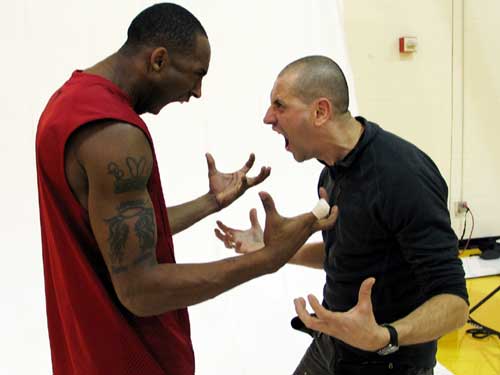
3) Kobe Bryant.


Kobe means "turtle" to the Waswahili.

They pronounce it like koh-bay, but so what? Akon is referred to as uh-KON! by all of the wannabe South Central thugs we play basketball with at Soweto. Akon and uh-KON!; Kobe and koh-bay; it's the same word. I'm calling him Kobe "Keep Your Head in Your Turtle Shell From Now On" Bryant.


Sloooooooowwlyyyyyyyyyyyyyyyy....


I doubt his folks were like Amani's and Kijana's. I think they were just trying to give their son an abstract namesake, not engender in him some mystical connection with East African shelled amphibians to help him play calmer. Err... reptiles. Or whatever turtles are.

[Just to prove I'm not the only one who is Not Smarter Than a Fifth Grader, read Hunter's answer to my editorial question:

"Uh.... (pause) .... shit. (pause, pause) They're reptiles."

(As he's cooking behind the wall, I can't see him. I hear nothing for the next six or seven seconds, except for the sound of a busted ass knife chopping up potatoes)

"Shit,"
and the silence was broken, "are they mammals?" (I laugh) "No, they're reptiles." (clearly thinking to himself) "I mean, they lay eggs."

He comes out of the kitchen to make his point.

"I'm going with reptiles."

I don't think Mwindaji should have a say, being from the North Carolinian village (Charlotte) that traded the future Hall of Fame turtle to the Lakers on draft day, back when Bryant was fresh out of Lower Merion High School.

--------------------------------------------------------------------------------

4) Kanye West.

Kanye is in a different category, not only because he's the only non-athlete of the bunch, but also because his name derives less from Kiswahili than from a language Biti refers to as Kiswahili cha mtaa: street Swahili.

That's that crack music, (insert word I don't even feel comfortable writing with asterisks for fear of political correctness)! That real black music, (insert word I don't even feel comfortable writing with asterisks for fear of political correctness)! Na-na-na-nah-nah-NAH-nah-nahhh!♫


"Numba two, mos def."


It sure is, Kanye. Always about cracks, and in your case, a black one.

Today when I hitched a ride from my village to town, I started chatting with the driver in Swahili. Naturally, I dropped a few lines that you don't learn in books, cha mtaa kabisa.

He asked what else I'd learned. I explained the difference (there is none) between mikasi ("multiple pairs of scissors") and mikasi ("sex"). That led to me learning the truth about Kanye West.

"Unamjua Kanye? Kanye West?"

"Ndiyo."

"Do you know what his name means in Kiswahili?"

"No."

He gathered himself for what he knew was going to be a fit of laughter.

"In Kiswahili, 'kanye' means, 'Go and take a shit.'"

For the son of a college professor, you'd think his mother would be better than that.

Hey mama, I wanna scream so loud for you, cuz I'm so proud'a you, and let me tell ya what I'm about to do...

Kanye in the commode.